
Datasets
We provide our cleansed versions of FAERS datasets as follow, from 2004Q1 to 2019Q1. Each quarter dataset has undergone drug name standardization, de-duplication of follow-up reporting records, and tedious error corrections. For detailed description, please view on here, or visit our GitHub.
Cleansed version of FAERS datasets
● Cleansed version of FAERS ASCII 2004Q1 - 2019Q1 (ZIP - 1.4GB)FAERS Data Preprocessing
This repository stores some script tools to cleanse the FAERS ASCII data. We use this dataset to build iADRs, an online web-based analytical system for detecting and analyzing suspected signals of adverse drug reactions and drug-interactions.
● Our changes to the original data We process not only FAERS data files but also the older AERS data. All records in these files are delimitated by newline (\n), and attributes by dollar sign ($), as illustrated in the following example snapshot. However, we found two peculiar cases that need special care, i.e., newline character in a record and abnormal attribute delimiter.

■ Newline character in a record
Some records contain newline characters (\n), like drug name or PT value. We guess FAERS did not examine every end-user's report. This character would wrongly divide a single record into two rows. As such, we checked each record to make sure the correct number of attributes, and resolved those with incorrect newline characters.
■ Abnormal attribute delimiter
According to FAERS data format, the first row defines the names of attributes. Consider the following example, which contains two attributes (PRIMARYID and PT), so every row should have two values delimitated by only one delimiter ($). But in the older AERS data (04Q1~12Q3), all records except those in the INDI table are ended by delimiter ($). This causes inconsistence, so we delete the extra dollar signs to make the older version consistent with the new FAERS data.

■ Attribute changes
FAERS attributes have been changed several times, which are summarized in the following table. An empty cell represents absence of the attribute in that time. For example, CASEVERSION was not introduced till 2012Q4, so it is absent before that time. This summarization also indicates the evolution of attribute names, which are highlighted with red color. For example, CASEID has been changed from CASE since 12Q3 and PRIMARYID changed from ISR. For those attributes that are still “active” in the current release, we always adopt the newest name, disregarding the time the attribute is introduced or changed, while for those “inactive” attributes, i.e., they are no longer used by FAERS, we still keep them but with missing values.

Another noticed issue is some attribute names are collided with SQL keywords. We append a baseline to distinguish them from SQL keywords. For example, the "ROUTE" attribute in the DRUG table is replaced by "ROUTE_": You can find a database's meta data in scripts/metadata.py.
■ New introduced attributes
We introduced several new attributes in the DEMO and DRUG tables.
1. DEMO
WT_KG: This weight attribute is calculated from WT and WT_COD, with unit in KG. AGE_TYPE: A discretization of AGE and AGE_COD attribute into 10 tags, based on the Age group in MeSH. You can check detail in this table.
2. DRUG
RXCUI: We transform the DRUGNAME attribute into rxcui code.
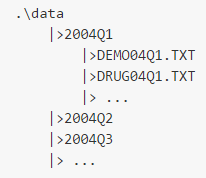
● Directory Structure Each quarter directory contains 7 files, including DEMO (DEMOGRAPHIC), DRUG (DRUG), REAC (REACTION), OUTC (OUTCOME), RPSR (REPORT), THER (THERAPY), and INDI (INDICATIONS). For example,
Useful Websites
● Useful Websites ■ FAERS
The US FDA Adverse Event Reporting System (FAERS) is a database that contains information on adverse event and medication error reports submitted to FDA. The database is designed to support the FDA's post-marketing safety surveillance program for drug and therapeutic biologic products. Adverse events and medication errors are coded to terms in the Medical Dictionary for Regulatory Activities (MedDRA) disclaimer icon terminology.
■ UMLS
The United States National Library of Medicine (NLM), operated by the United States federal government, is the world's largest medical library.
■ PubMed
PubMed is a free search engine accessing primarily the MEDLINE database of references and abstracts on life sciences and biomedical topics. The United States National Library of Medicine (NLM) at the National Institutes of Health maintains the database as part of the Entrez system of information retrieval.
■ RxNorm
RxNorm is a name of a US-specific terminology in medicine that contains all medications available on US market. It can also be used in personal health records applications. It is part of UMLS terminology and is maintained by National Library of Medicine.
■ MeSH
MeSH (Medical Subject Headings) is the NLM controlled vocabulary thesaurus to provide a hierarchically-organized indexing terminology for indexing and cataloging of biomedical information such as MEDLINE/PUBmed and other NLM databases.
■ SIDER
SIDER contains information on marketed medicines and their recorded adverse drug reactions. The information is extracted from public documents and package inserts. The available information include side effect frequency, drug and side effect classifications as well as links to further information, for example drug–target relations.
■ MedDRA
MedDRA or Medical Dictionary for Regulatory Activities is a clinically validated international medical terminology dictionary (and thesaurus) used by regulatory authorities in the pharmaceutical industry during the regulatory process, from pre-marketing to post-marketing activities, and for data entry, retrieval, evaluation, and presentation. In addition, it is the adverse event classification dictionary endorsed by the International Conference on Harmonisation of Technical Requirements for Registration of Pharmaceuticals for Human Use (ICH).
References
● Reference Papers ■ W.Y. Lin, H.Y. Li, J.W. Du, W.Y. Feng, C.F. Lo, and V.W. Soo, “iADRs: Towards on-line adverse drug reaction analysis,” SpringerPlus, vol. 1, no. 1, 72 , 2012.

■ W.Y. Lin and J.W. Du, “Towards on-line ADR detection: An innovative data cube-based approach,”The 14th World Congress on Medical and Health Informatics (Medinfo 2013), Denmark, August 20-23, 2013.
■ W.Y. Lin and C.F. Lo, “Co-training and ensemble based duplicate detection in adverse drug event reporting systems,” The 2013 IEEE International Conference on Bioinformatics and Biomedicine (BIBM 2013), China, December 18-21, 2013.
■ W.Y. Lin, L. Lan, and F.S. Huang, “Rough-set-based ADR signaling from spontaneous reporting data with missing values,” Journal of Biomedical Informatics, vol. 58, pp. 235-246, 2015.
 Computational Intelligence Lab. Department of Computer Science and Information Engineering, National University of Kaohsiung